
Case study, sorting facility for separately collected recyclables
Trigironde: characterising residues to inform investment decisions
SPL Trigironde relies on the analysis of its residue line to better understand the materials present and to study additional recovery options. NextWaste’s support provides measurement evidence intended to inform investment decisions.
Olivier Guilmois, Managing Director, SPL Trigironde
The context
Better understanding the line to study recovery options
Residues at the Saint-Denis-de-Pile sorting facility pass over a sorting table in a cabin, where operatives recover recoverable materials before the residues are removed. The SPL wanted to better understand the materials present on this line, in order to study additional recovery options.
Knowing the waste stream
Identify the families of materials present at the observation point, using the local authority’s characterisation grid.
Testing against field conditions
Compare the automatic reading with manual characterisations, to establish a reading suited to the site.
Informing the decision
Document the recovery options before any investment.
Setting the optical sorters more aggressively is not an answer in itself: unwanted items would be pushed onto the other tables. The whole challenge is to find the right balance.
The system
A six-month contracted audit, installed in under two hours
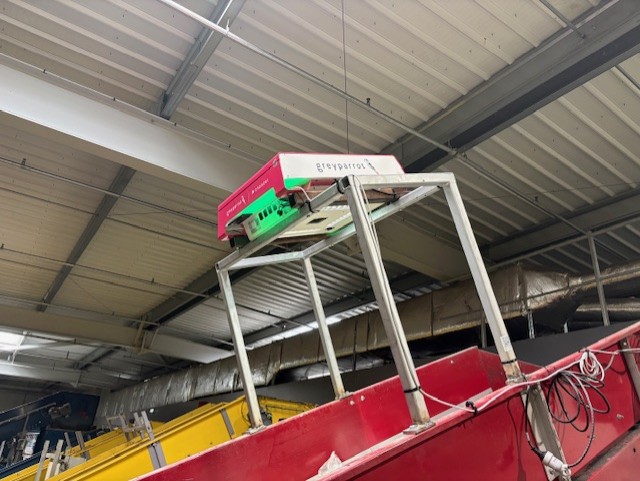
An AI vision analyser is positioned above the conveyor for large residues, upstream of the cabin. It observes the waste stream continuously and identifies the objects visible on the surface of the belt. The SPL chose simplicity: a six-month contracted audit, with no change to the process, so as to have measurement evidence before any investment decision. The analyses began in June 2026.
- Less than €500
- for the support, made by a local craftsman and fixed to the existing conveyor.
- Less than 2 h
- of installation, with the power supply and the network close by.
- Citeo grid
- the measurement uses the characterisation categories already used by the local authority.
- 5 cm mesh
- any object smaller than 5 cm is counted as fines, whatever its material, according to the site’s convention.
The method
Testing AI against field conditions
The observations are compared with manual characterisations to establish a reading suited to the site’s categories and conditions.
Time-stamped cross-calibration
For two to three weeks, NextWaste and the site compared the analyser’s reading with manual characterisations. The protocol is simple and demanding: at a given time, the operatives at the table stop, and everything on the table is collected, characterised and photographed. These results are then compared with what the analyser read over the same period, until the gap is reduced to a minimum.
Reports and alerts
The SPL receives a period report, alerts and a count of materials by category. This continuous reading complements sample-based characterisations, without replacing them.
An operator on board
The site operator was involved in the approach. The measurement provides a common basis for discussion with the SPL, in particular on the settings of the optical sorters. For Olivier Guilmois, “it is a tool that lets you both understand your process and take action”.
What the measurement provides
More precise knowledge of the waste stream
The analysis highlights the families of materials present at the observation point and provides evidence for comparing recovery options.
Testimonial
In Olivier Guilmois’s words
“There are always investments to make in a sorting facility; you have to choose the most relevant ones.”
What next
Documenting the options before investing
The results feed into the study of additional solutions. To date, no investment has been decided.
An option under study
The analyser could control an ejector sending packaging back to the optical sorting loop, subject to modifying a chute.
The role of the operatives
If this option were chosen, the operatives at the table could concentrate on fibre-based materials.
Value still to be confirmed
The technical and economic value of these options remains to be confirmed before any deployment decision.
Reading guide
The limits to bear in mind
- The observation point is upstream of manual sorting. On its own, it therefore does not describe the final performance of the facility.
- Accuracy is not the same for an object count as for a mass estimate; that is the whole purpose of cross-calibration.
- These results are specific to the configuration and the waste stream of this site. Each sorting facility has its own balance.
Want to understand a waste stream better before investing?
Let’s look at the useful measurements and the validation conditions for your site.
Other case studies
Testimonials gathered at the NextWaste webinar “IA en centre de tri : retours d’expériences de l’analyse continue” (AI in sorting facilities: feedback on continuous analysis), held in French on 17 September 2026; the quotes on this page are translated from French. Translated from the French version updated on 3 October 2026.